About full cost vs unit cost
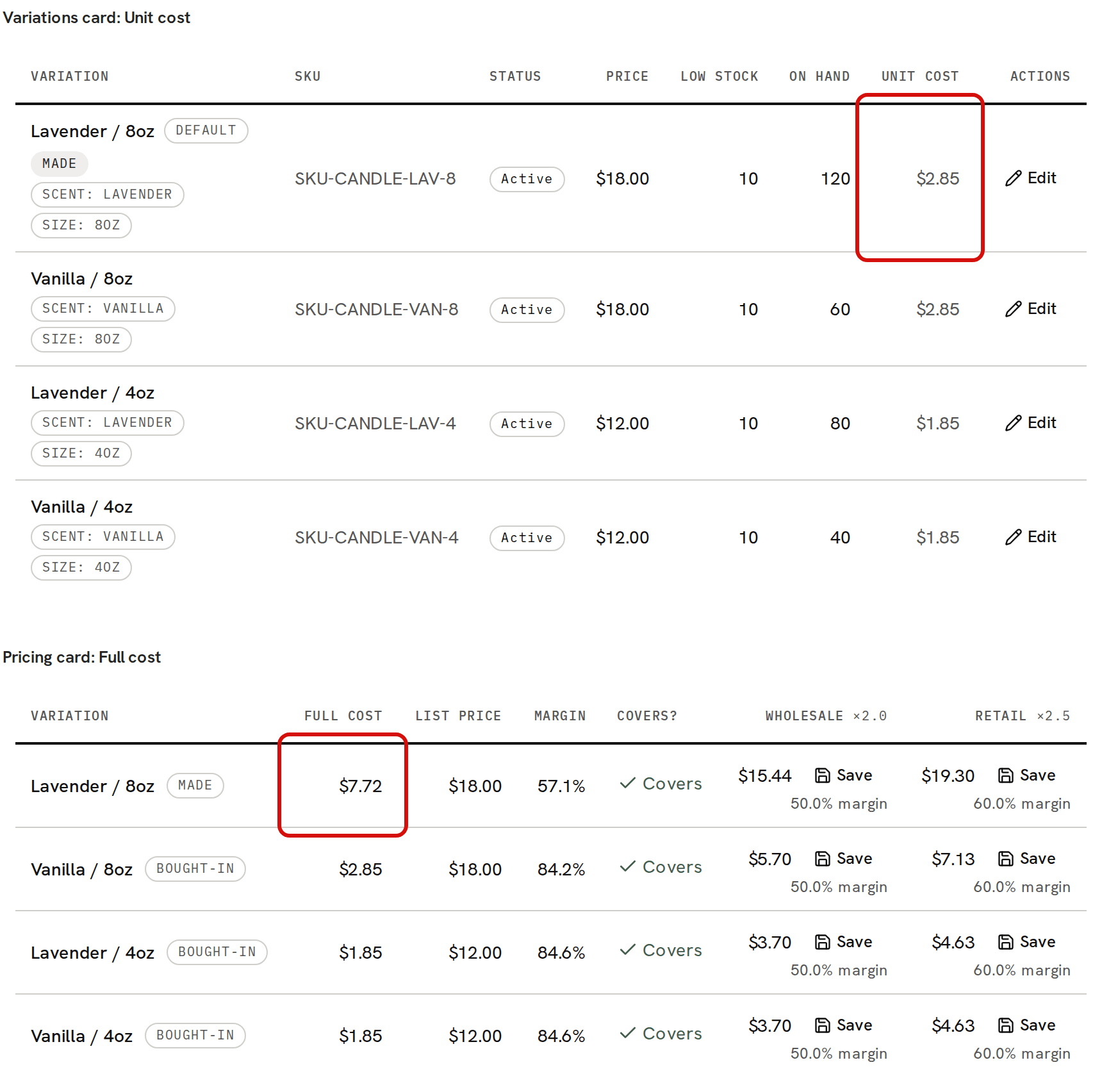
Why Products shows $2.85 for a candle while Pricing shows $7.72: the average cost of the stock you hold, against the recipe worked out today.
The short answer
- Unit cost, on Products and on a product's page, is what the stock you hold cost you: its weighted-average cost.
- Full cost, on Pricing, is what one more unit costs to make today: the recipe at today's material costs, plus labor and the recipe's flat overhead.
- The two are different numbers by design. Neither is wrong, and one is never a stand-in for the other.
- Price from Full cost. Your sales are costed from Unit cost.
Two different questions
Unit cost answers "what did the units on my shelf cost me?". Full cost answers "what will the next one cost me to make?". When your material prices, your labor rate or your recipe change, the second answer changes at once. The first only changes when you make, or adjust, more stock.
Unit cost: what your stock cost
Every product variation carries a weighted-average cost: the average of what its stock cost you. For a product you make, completed batches set it. Each batch's cost is its materials, at their weighted-average costs when the batch started, plus labor, and it is averaged in with the stock you already had. For a product you buy in, the cost basis you give when you adjust its stock sets it.
This is the Unit cost column on Products and in a product's Variations card. It is also the cost your sales use. When you fulfill an order, each line's COGS is its quantity times this cost.
A batch never includes the recipe's flat overhead, so neither does Unit cost.
Full cost: what one more costs to make now
For a variation with a recipe (Made), Full cost on Pricing is the recipe worked out right now: every material at its current weighted-average cost, waste included, plus labor, the recipe's minutes at your labor rate, plus the recipe's flat overhead, divided by what the recipe makes. It moves every time one of those moves.
It is the same figure as the With overhead: line on the recipe's page. The recipe's headline, Unit cost (incl. labor), is that figure without the overhead.
Worked example: Lavender / 8oz in the sample workspace
The 120 Lavender / 8oz candles in stock carry $2.85 each, the cost the sample workspace starts with. That is their Unit cost.
The candle's recipe, worked out at today's costs, comes to $7.72 on Pricing:
- $5.02 of materials: 200 g of soy wax, 16 ml of fragrance oil, a wick, a jar and a label;
- $2.50 of labor: 10 minutes at $15.00 an hour;
- $0.20 of flat overhead.
Without the overhead that is $7.52, the recipe's Unit cost (incl. labor). The next batch you make is costed at that $7.52 a candle, not $7.72, because batches leave overhead out. Averaged in with the 120 at $2.85, the new candles lift the Unit cost a little. Every batch pulls it closer to $7.52. It equals $7.52 only when a batch goes onto an empty shelf.
Bought-in products
A variation without a recipe (Bought-in) has no recipe to work out. Its Full cost on Pricing is its weighted-average cost, so the two numbers are the same.
Which one to price from?
Price from Full cost. It is what the next unit costs you, overhead included, and it follows your material prices as they change. Pricing compares your list price with it and bases its suggested prices on it.
Unit cost tells you what your sales are costed at today, and what your stock is worth. When it is far below Full cost, your current stock was cheaper to make than the next batch will be, and your margins will shrink as it sells out.